
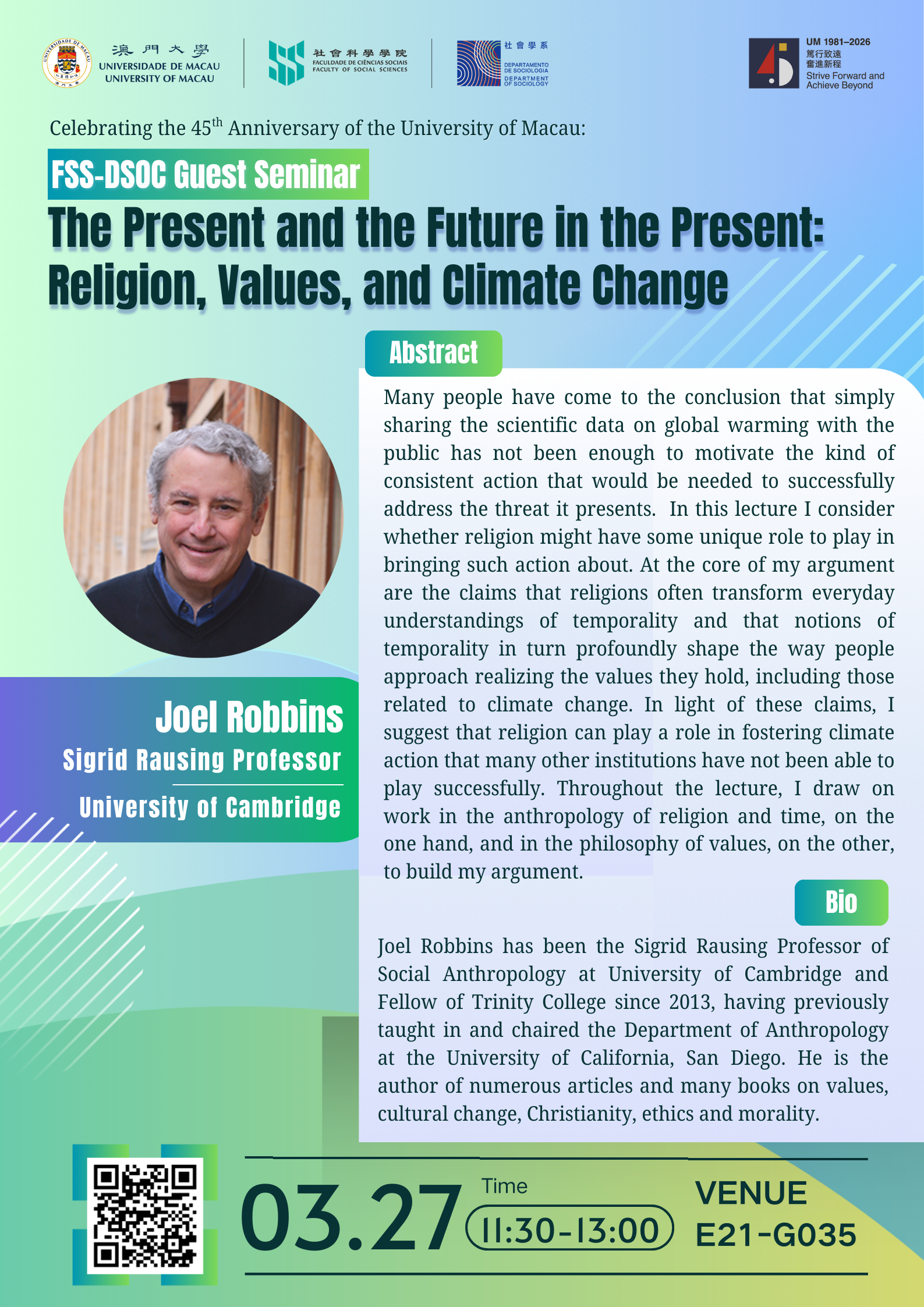
Date: March 27
Time: 11:30 am – 1:00 pm
Speaker: Prof. Joel Robbins
Venue: E21A-G035
Organizer: Department of Sociology
Phone: 8822 4595
Many people have come to the conclusion that simply sharing the scientific data on global warming with the public has not been enough to motivate the kind of consistent action that would be needed to successfully address the threat it presents. In this lecture I consider whether religion might have some unique role to play in bringing such action about. At the core of my argument are the claims that religions often transform everyday understandings of temporality and that notions of temporality in turn profoundly shape the way people approach realizing the values they hold, including those related to climate change. In light of these claims, I suggest that religion can play a role in fostering climate action that many other institutions have not been able to play successfully. Throughout the lecture, I draw on work in the anthropology of religion and time, on the one hand, and in the philosophy of values, on the other, to build my argument.
Joel Robbins has been the Sigrid Rausing Professor of Social Anthropology at University of Cambridge and Fellow of Trinity College since 2013, having previously taught in and chaired the Department of Anthropology at the University of California, San Diego. He is the author of numerous articles and many books on values, cultural change, Christianity, ethics and morality.
Much of his work to date has focused on helping to construct theoretical models of the role of values in social life generally and in processes of radical cultural change in particular. Robbins latest research focuses on the nature of religious knowledge and processes of religious education. His publications include the books Becoming Sinners: Christianity and Moral Torment in a Papua New Guinea Society and Theology and the Anthropology of Christian Life, and numerous edited volumes, including most recently Where is the Good in the World: Ethical Life Between Social Theory and Philosophy (Berghahn, 2022).