
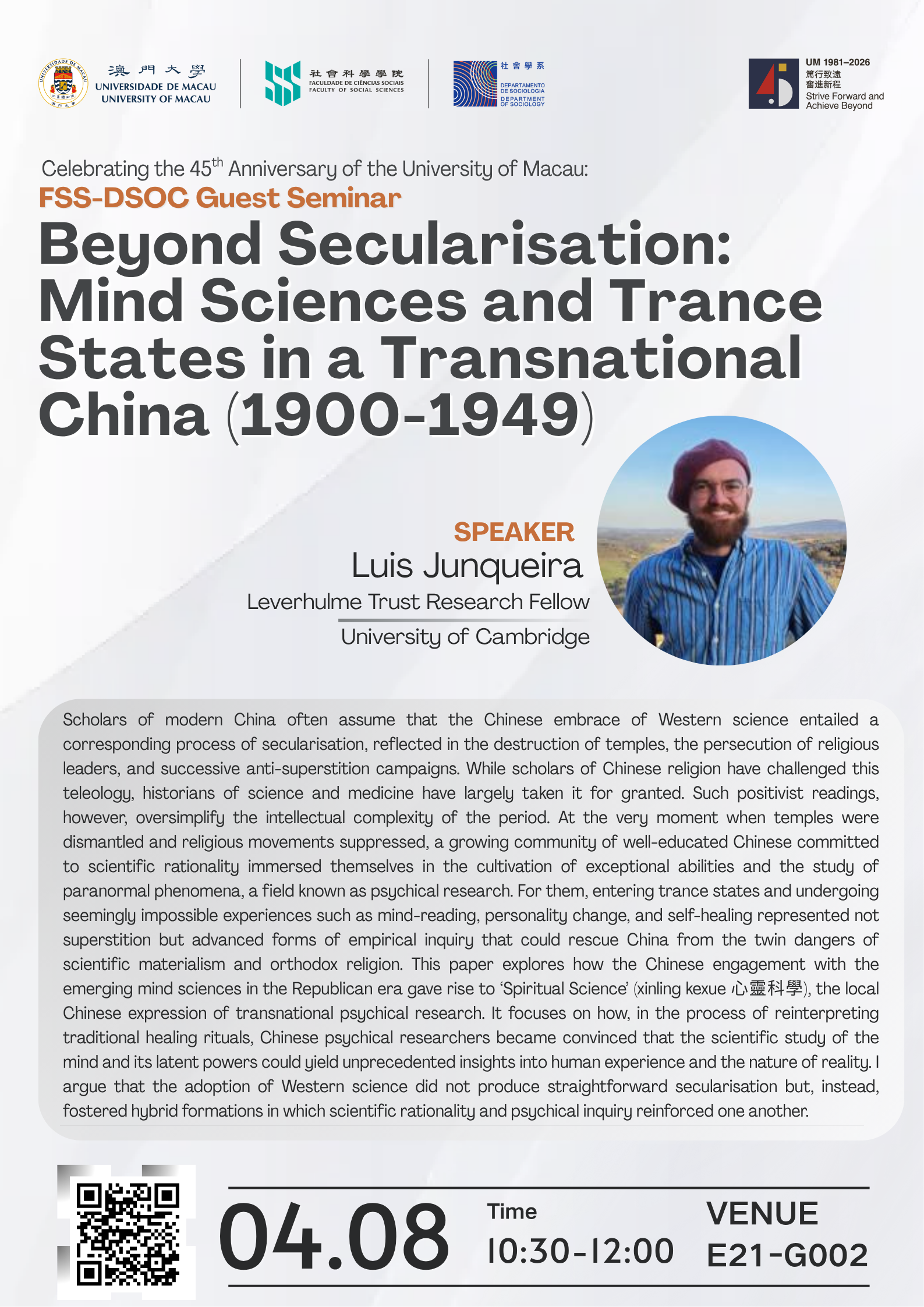
Date: April 8
Time: 10:30 am – 12:00 pm
Speaker: Dr. Luis Junqueira
Venue: E21B-G002
Organizer: Department of Sociology
Phone: 8822 4595
Scholars of modern China often assume that the Chinese embrace of Western science entailed a corresponding process of secularisation, reflected in the destruction of temples, the persecution of religious leaders, and successive anti-superstition campaigns. While scholars of Chinese religion have challenged this teleology, historians of science and medicine have largely taken it for granted. Such positivist readings, however, oversimplify the intellectual complexity of the period. At the very moment when temples were dismantled and religious movements suppressed, a growing community of well-educated Chinese committed to scientific rationality immersed themselves in the cultivation of exceptional abilities and the study of paranormal phenomena, a field known as psychical research. For them, entering trance states and undergoing seemingly impossible experiences such as mind-reading, personality change, and self-healing represented not superstition but advanced forms of empirical inquiry that could rescue China from the twin dangers of scientific materialism and orthodox religion. This paper explores how the Chinese engagement with the emerging mind sciences in the Republican era gave rise to ‘Spiritual Science’ (xinling kexue 心靈科學), the local Chinese expression of transnational psychical research. It focuses on how, in the process of reinterpreting traditional healing rituals, Chinese psychical researchers became convinced that the scientific study of the mind and its latent powers could yield unprecedented insights into human experience and the nature of reality. I argue that the adoption of Western science did not produce straightforward secularisation but, instead, fostered hybrid formations in which scientific rationality and psychical inquiry reinforced one another.
Luis Junqueira is a global historian of medicine, science, and religion in modern China. He is currently a Leverhulme Trust Research Fellow at the University of Cambridge’s Department of History and Philosophy of Science. His research focuses on the transnational history of the mind sciences, mental health, and alternative therapies in East Asia and South America. He is particularly interested in the role of laypeople in creating health knowledge and is committed to decolonising his field. Junqueira completed his PhD at University College London and had held fellowships at the universities of Strathclyde and Tohoku.